Initiative 01 · Connectivity
When Even Urban Nepal Struggled for Internet, These Villages Already Had It
With initial support from the High Level Commission for Information Technology (HLCIT), CRED implemented the E-Village initiative across Kavrepalanchowk district — establishing Internet connectivity for schools and health institutions through wireless network infrastructure beamed out from a relay point above Nagarkot.
In its first phase, 11 secondary and higher secondary schools across 7 VDCs were connected via wireless Internet from the urban center — at a time when reliable connectivity was scarce even in Nepal’s cities. The result: 9,909 students and 393 teachers gained Internet access, with schools acquiring computers, printers, photocopiers, and multimedia projectors through a mix of their own effort and donated equipment.
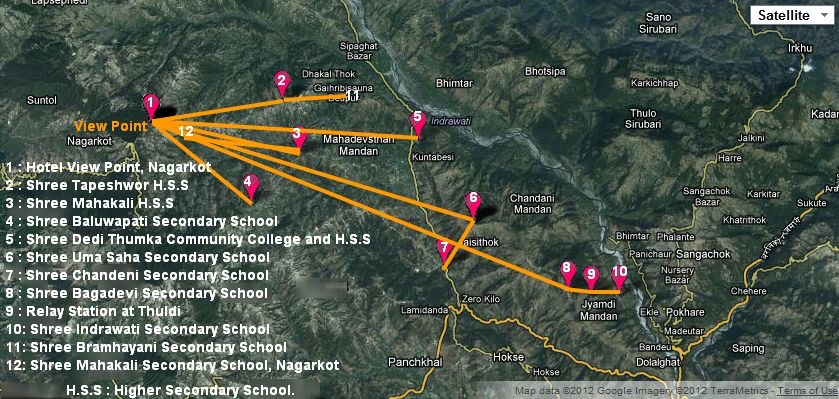
The actual wireless network map, 2011 – 11 schools connected via a single relay point at Nagarkot.
15.24 km
Longest single wireless link – Point-to-point, from the Nagarkot relay to Shree Bagadevi Secondary School
512 Kbps
Total shared bandwidth across all 11 schools at launch
“This work drew outside attention early on. In 2011, a team from the Nepal Research and Education Network (NREN) — including Prof. Christopher Hoadley of New York University and the then–Vice Chairman of HLCIT — visited CRED’s project schools directly, at the invitation of CRED’s chairman, to see the model firsthand and offer technical recommendations.”
At Shree Dedi Thumka School, students began producing their own wall magazines — handwritten community bulletin boards students wrote and illustrated themselves. Visiting the school, the team found students already active on Facebook and using mobile data to look up reference material, alongside a computer teacher appointed specifically to run the new lab. At Shree Mahakali Higher Secondary School, former students returning from university in nearby cities began voluntarily teaching basic computer literacy classes to their old community — for a small fee open to any interested local resident.
Initiative 02 · Capacity building
Teaching the Teachers First
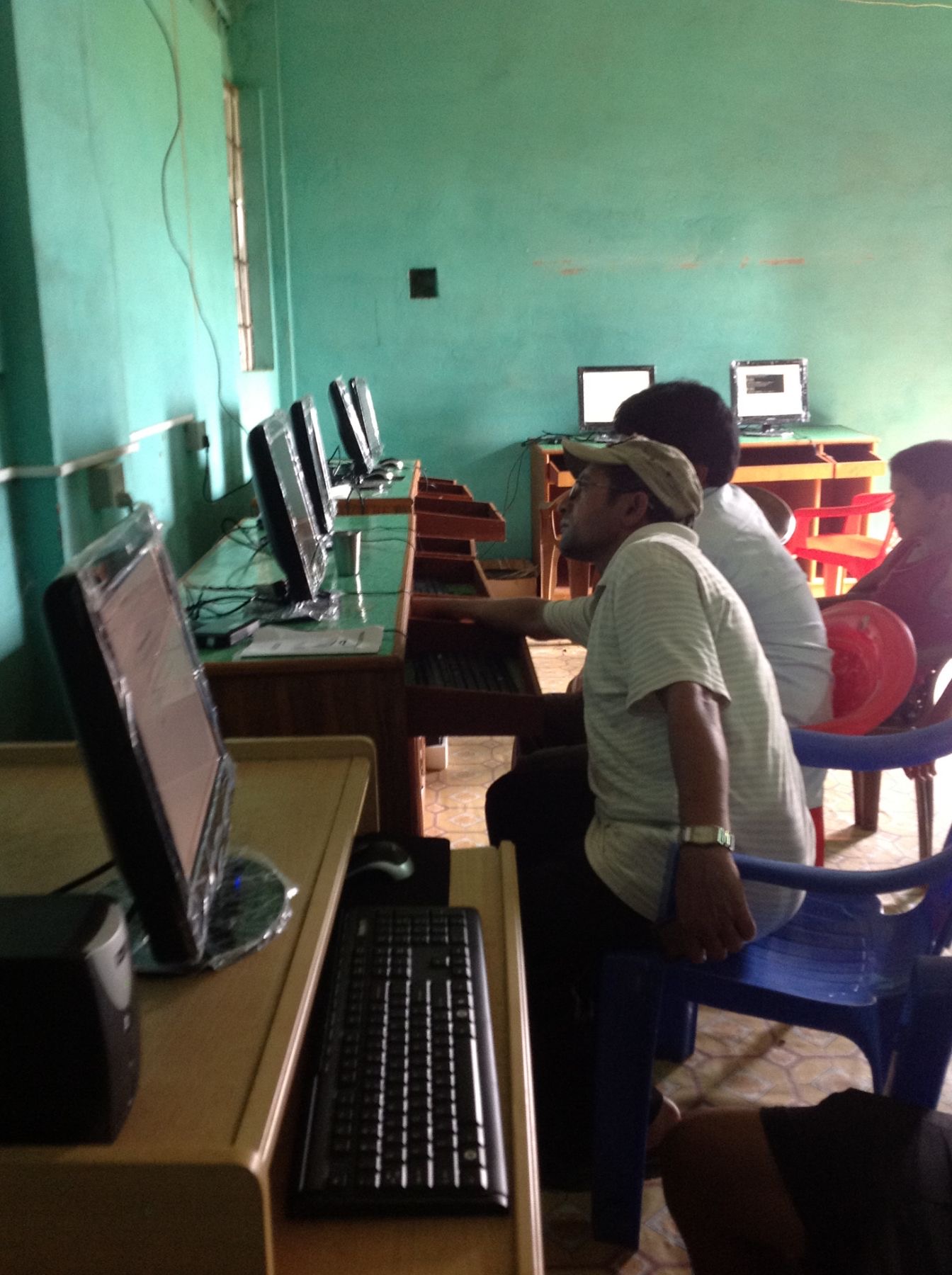
Connectivity alone doesn’t change a classroom — teachers do. CRED put sustained effort into building digital literacy among teachers so they could use ICT tools effectively in their own lessons. Early on, this met real resistance: computers were unfamiliar, and many teachers had never used one. Today, digital activity is a routine part of daily teaching across CRED’s member schools — a shift that took years of persistence, not a single training session.
In the initiative’s early phase, 20 teachers from each of the 7 VDCs became CRED’s first cohort of digitally literate teachers — the seed group that eventually normalized computer use in the classroom.
Initiative 03 · Classroom Foundations
The Unglamorous Work That Makes Teaching Work
Prepared lesson plans and purpose-built teaching materials are the foundation of any quality classroom — but they weren’t consistently practiced across member schools. CRED addressed this directly, running continuous capacity-building activities to help teachers build and use real teaching materials and lesson plans, subject by subject. Early efforts focused on English, Math, and Science, with other subjects added as the practice took hold.
Initiative 04 · Curriculum
A Curriculum Written By the Community It Serves
CRED works directly with the municipality to design a local curriculum — one that reflects Mandan Deupur’s own context rather than a generic national template. CRED facilitated a series of knowledge-sharing sessions and brought in expert input throughout the design process.
As far back as 2067 BS, CRED’s own internal planning had flagged “a common curriculum for 7 VDCs” as a future goal, not yet achieved. Today, that early aspiration is an active, ongoing program — one of the clearest examples of CRED setting a long-term goal and following through on it across two decades.
Initiative 05 · Indigenous Knowledge
Community as an Open School
CRED has always treated the community itself — not just the classroom — as a place of learning. As part of that principle, CRED brings local artisans, elders, and skilled community members into schools to teach traditional technologies, crafts, and knowledge directly to students — passing skills to the next generation before they’re lost. It’s a simple idea with a specific purpose: making sure a child’s education includes what their own community already knows, not only what a textbook provides.
Initiative 06 · Daily Practice
The Standards Behind Every School Day
01
Student Enrollment
Door-to-door enrollment campaigns and annual data tracking pushed enrollment to 98% across member schools.
02
Grade Teaching
Dedicated, trained teachers for early grades (1–3), rather than rotating general staff.
03
Classroom Management
Physically and instructionally organized primary classrooms, decorated with teaching materials at every member school.
04
Library & Book Corner
Reading corners established in early grades, with full libraries expanding to every school.
05
Learning Achievement Analysis
A structured system to track student learning outcomes over time, not just exam scores.
06
Co-Curricular Activities
Regular inter-school competitions at ward and municipality level.
07
English-Medium Instruction
Introduced gradually starting from nursery and grade one, expanding upward.
08
Dress, Bag & Snacks
Basic equity measures made compulsory across schools, reducing visible gaps between students.
09
ICT in the Classroom
Multimedia projectors and computer-based teaching aids used in daily lessons, not just dedicated computer periods.
10
Remedial Teaching
Targeted extra support delivered specifically in grades 1, 3, 5, 8, and 10.
11
Student Progress Reporting
Every parent receives a report card each term.
12
Attendance & Drop-Out Tracking
Systematic tracking of both teacher and student attendance, with direct follow-up to bring drop-out students back to school.